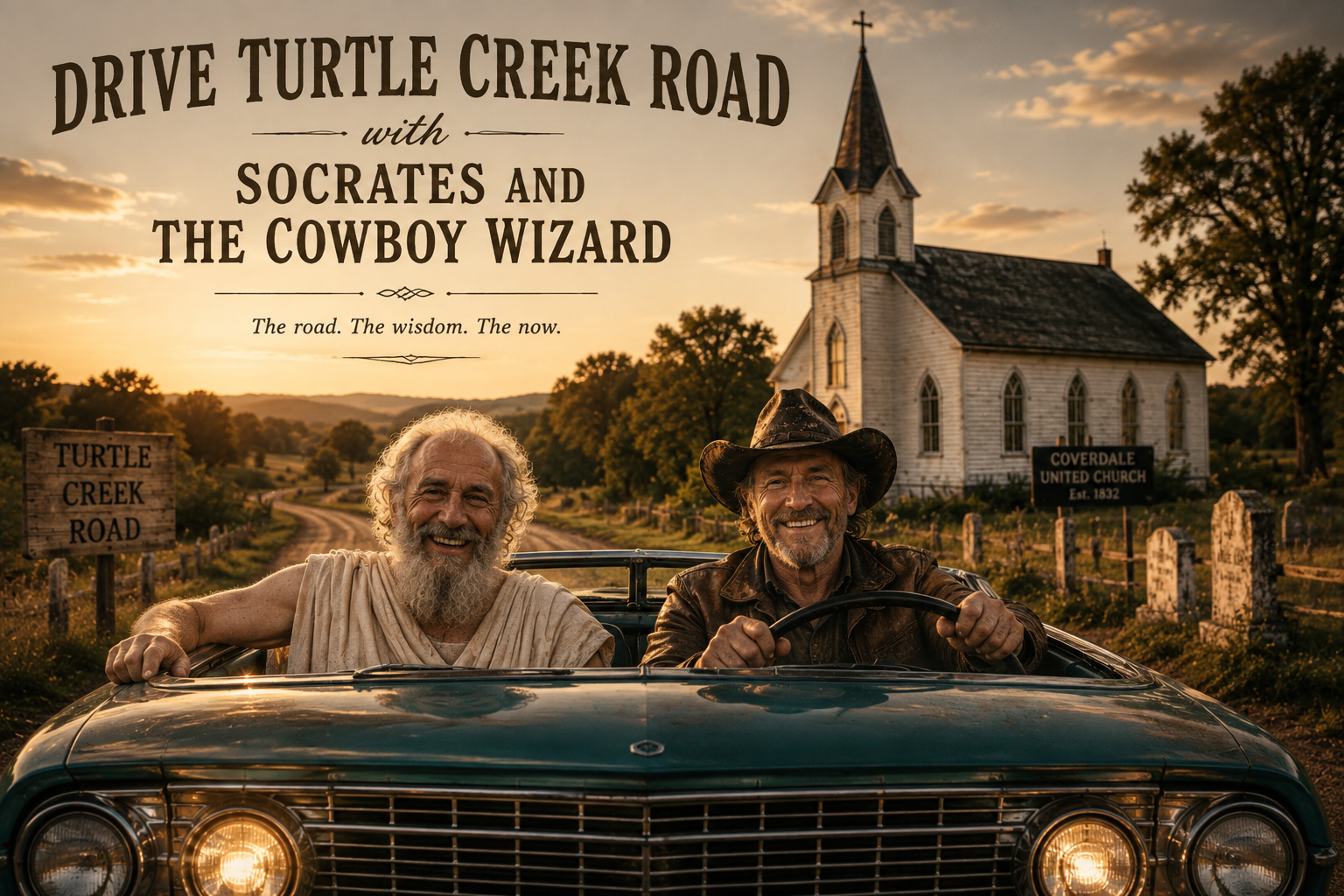
Drive Turtle Creek Road with Socrates and the Cowboy Wizard
I love the country road drive.
The quiet isolation. The simplicity. The time to think—or, most often, not think.
Sometimes I feel the back-country road drive is an escape, and other times a search for paradise.
Maybe I’m searching for a wizard.
He’s wearing a cowboy hat that’s been worn beyond the measurement of time. That hat has marks, nicks and stains, but somehow it is just right at any given moment you look at it.
Funny how you can see a guy wearing a brand-new, store-bought, unmarked cowboy hat and somehow know he’d have a problem even picking out a cow from a horse.
The Cowboy Wizard would tell me to just nod at the dude and be happy for him.
“Let him ride his own trail, kid. Just stay on your path,” the Cowboy Wizard would say.
And so I drive.
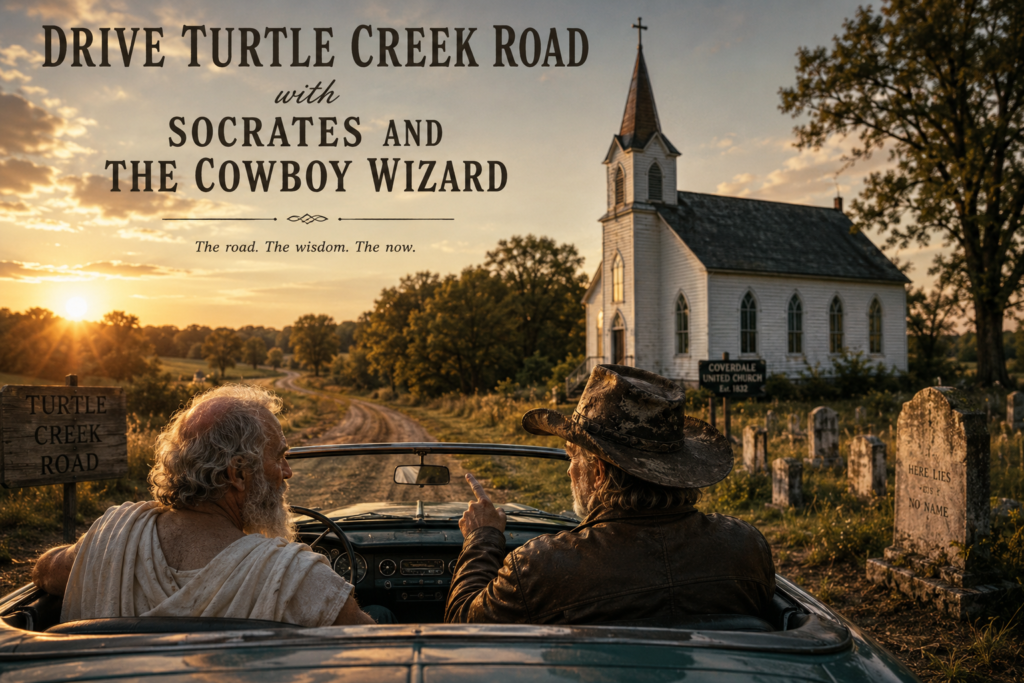
My left hand smoothly slides around the circle of the steering wheel as the graveyard comes into view. I let the drop of my hand touch the turn signal.
I glance toward the gravestones, many of them scrubbed clean by an attempt years ago to make the old stones look new again.
There’s an irony in that. In trying to preserve the stone, we erased something of the person.
The surface remained.
The name disappeared.
Here lies… no name.
Marcus Aurelius reminded himself that eventually both the remembered and those doing the remembering disappear. Time has a way of erasing the names we once thought would last forever.
A sobering thought beside a cemetery whose stones have already had their names erased for them.
Then I see the steeple.
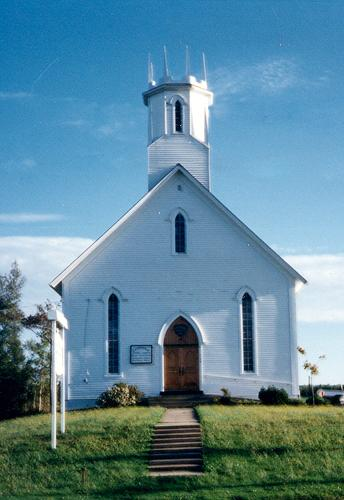
The old Coverdale United Church stands beside the road, its white wooden walls and narrow Gothic windows belonging to another time. It has watched generations travel this road—families arriving, children growing, people marrying, grieving, praying and eventually disappearing into the same earth as those whose stones now stand nearby.
The Church is a sign of refuge, of a path to a peaceful place.
Not the Church itself.
I pass the Church.
For me, the Church is just a marker where I turn and find the back roads of solitude.
There’s always a slight grin that glides over me as I make that turn, because in some strange way I am entering another church entirely:
the Church of My Mind and Soul.
Every person should attend the Church of their Inner Solitude from time to time.
This marker lets me know I’m about to journey down Turtle Creek Road.
And somewhere along the road, the Cowboy Wizard speaks again.
“You’re never back there, or somewhere, or almost there—you’re here.”
“It’s that simple,” Cowboy Wizard would say.
“People want to turn themselves around and hash up the past. All that turning around gets people tied up in knots.”
He shakes his head.
“Then they wonder why they’ve got anxiety, when they just turned their mind and body into a pretzel.”
He looks ahead through the windshield.
“You got to look at where you are and where you are going.”
“Yeah, but things have happened in our past that have created us,” I tell him. “Things that affect us, effect us…and sometimes infect us.”
“Sure there are,” says Cowboy Wizard. “Those things are signposts. I’m not asking you to say they never happened, that they didn’t occur. They did-done.”
I glance over at him.
“They did-done?”
“Yeah. They did happen, and now they are done.”
I let that sit for a moment.
“So they’re best used as signposts?”
“Exactly. Reminders. Whatever happened back there can help you decide to make a better choice NOW.”
He points through the windshield.
“And people spend just as much time trying to see too far ahead. Unless they got some miracle giraffe neck, they should just look at what they can see on the road NOW.”
I laugh.
“So that’s it, Cowboy Wizard? Just live in the now?”
He shakes his head.
“Nah. People like to throw around clichés, cut out quotes and stick ’em somewhere. Nothing wrong with that. But a quote’s about as useful as an alarm clock.”
“An alarm clock?”
“Sure. You hear the noise, and that’s a signal to get moving. But most people just hit the snooze button, don’t they?”
He has a point.
“Knowing something ain’t the same as living it,” he continues. “And if they finally do get moving, half the time they’re already late. Then they spend their time making excuses about why they’re late.”
Outside the window, Turtle Creek Road keeps unfolding in front of us.
“And while all that is going on, they’re anxious about what just happened and worried about what’s going to happen—which nobody really knows anyway.”
He pauses.
“So they forget where they actually are.”
“Where?”
He looks at me.
“NOW.”
He turns back toward the windshield as if the matter has been settled.
Maybe it has.
I drive for a while without saying anything.
Turtle Creek Road rolls beneath us—smooth pavement for a stretch, then bumps and potholes. It twists, climbs and falls, revealing a little more of itself with every turn.
Never the whole road.
Only enough to keep going.
“Yeah, that’s life, Socrates!” Cowboy Wizard suddenly laughs, pulling off his battered old hat and hanging his head out the window.
I laugh too.
But his words stay with me.
Maybe that is life.
We spend so much of it wanting to know what’s beyond the next bend that we overlook the few feet of road actually entrusted to us.
The Turtle Creek drive is like any journey.
You need fuel. You have to choose a road. Sometimes you’ll make the wrong turn. Sometimes the road itself will change beneath you.
But eventually the question becomes less about where you’re going and more about who is doing the travelling.
And then there are the passengers.
Some stay for miles.
Some for only a moment.
Some make the drive easier.
Some make you wonder why in hell you ever let them into the car.
Tolerate them.
Enjoy them.
Judge them—we all do.
But ultimately, love them.
Because perhaps every person who travels beside us reveals something about the person sitting behind the wheel.
“You hear that, Socrates?” Cowboy Wizard asks.
I glance over.
“You are me…and I’m you.”
This time, I don’t laugh.
I look at him.
The battered hat. The weathered face. That irritating little grin that seems to know something I haven’t figured out yet.
And perhaps I finally understand why I’ve never been able to find the Cowboy Wizard anywhere except on these roads.
He was never waiting somewhere down Turtle Creek Road.
I brought him with me.
Ah, the wisdom of the Cowboy Wizard.
The Stoics understood something similar long before either of us took this drive: it is not the things, events or people themselves that disturb us—it is our judgment about them.
And judgment belongs to the person behind the wheel.
Me.
The past is behind me.
The future is somewhere beyond the next bend.
Neither is where I am.
The church disappears in the mirror.
The cemetery is gone from sight.
Ahead, Turtle Creek Road bends again and disappears among the trees.
I have no idea what is around that corner.
But I know where I am.
Here. NOW.
Cowboy Wizard pulls his battered hat down over his eyes.
“Watch the road, Socrates.”
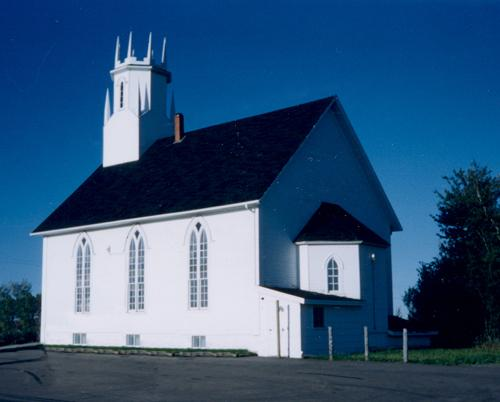
Coverdale United Church is a graceful white wooden Carpenter Gothic church overlooking the Petitcodiac River along Coverdale Road in Riverview, New Brunswick. Built in 1865, its simple yet elegant design is distinguished by steeply pitched rooflines, tall narrow Gothic-arched windows, vertical wooden clapboard siding, and a prominent square entrance tower crowned with an open belfry. The building’s modest proportions, symmetrical façade, and understated architectural details reflect the craftsmanship and rural character of nineteenth-century Maritime churches. Set on a gently elevated property beside its historic cemetery, the church remains a striking landmark that evokes both simplicity and quiet dignity.
Coverdale United Church
The history of Coverdale United Church reaches back to 1828, when a small Methodist meeting house was erected to serve settlers along the Petitcodiac River. At the time, it was the only Methodist church on the circuit between Dorchester and Saint John, continuing the work begun by early Wesleyan missionary Rev. William Black in the late eighteenth century.
As the congregation grew, the present Carpenter Gothic church was constructed in 1865, becoming both a place of worship and a centre of community life for generations of local families. Following the formation of the United Church of Canada in 1925, the congregation officially became Coverdale United Church, continuing a long tradition of faith, fellowship, and service.
The building underwent significant renovations in 1904, and in 1983 it was carefully relocated to its present site along Coverdale Road to ensure its preservation. Recognizing both its architectural significance and its important role in the religious history of southeastern New Brunswick, it was designated a Provincial Historic Site.
After serving the community for more than 150 years, the congregation was dissolved in 2017, and the church was thoughtfully converted into a private residence. Although its purpose has changed, the building remains a treasured landmark and a tangible reminder of the generations who gathered within its walls for worship, celebration, comfort, and community.
Beside the church lies the historic Coverdale Cemetery, established in 1819, where many of the area’s earliest settlers rest. Together, the church and cemetery stand as enduring symbols of the region’s spiritual, cultural, and historical heritage.