
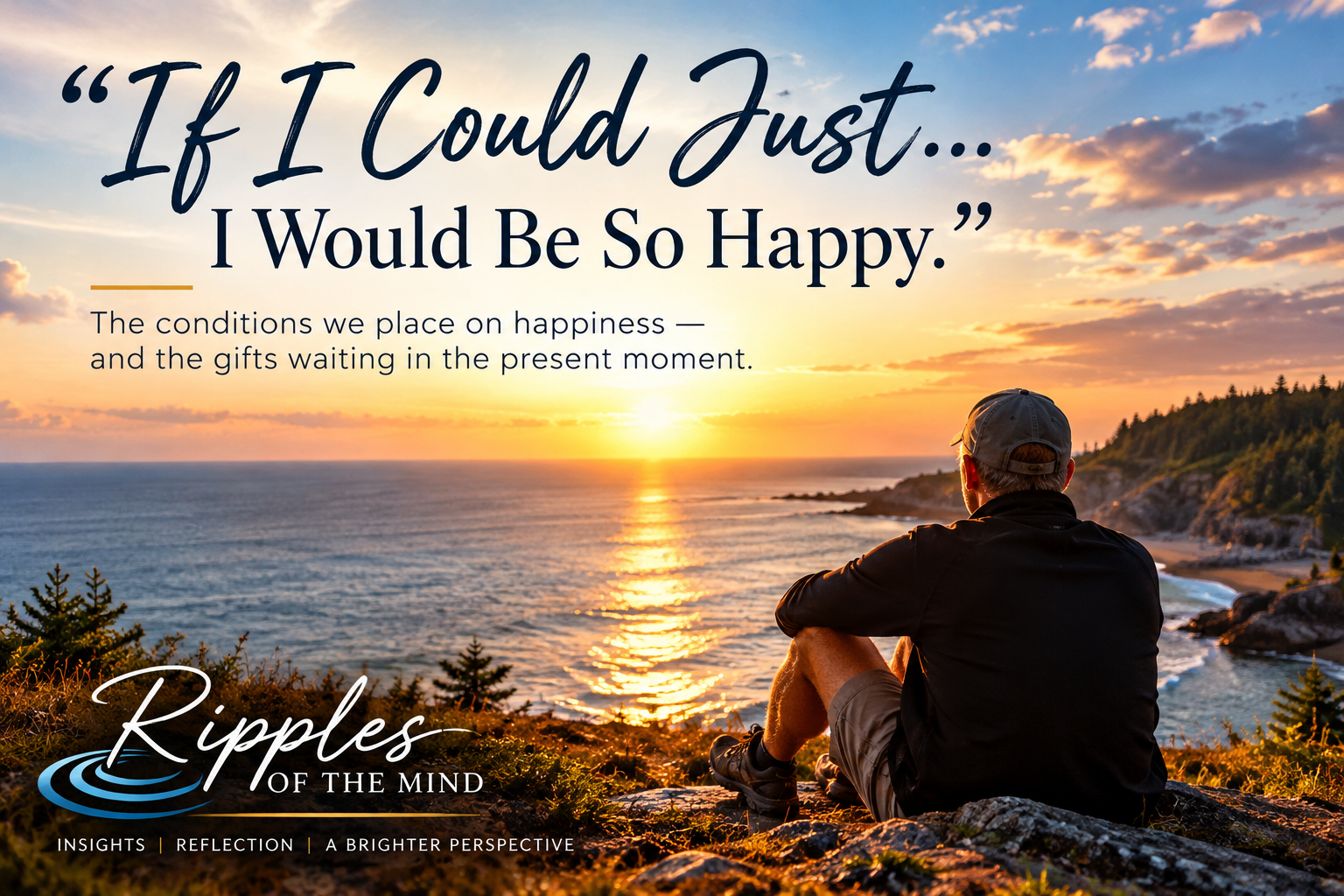
“If I Could Just… I Would Be So Happy.”
The conditions we place on happiness — and the gifts waiting in the present moment.
Ripples of the Mind | Insights
By Chuck Bates
Have you ever found yourself somewhere beautiful, surrounded by everything you need to enjoy the moment, and thought:
“If I could just be here every day, I would be so happy.”
Perhaps you were standing beside the ocean, walking through a forest, or enjoying a peaceful afternoon with someone you love.
For a moment, everything felt right.
And then, almost without noticing, your mind wandered toward what was missing.
If I could just have more days like this…
If I could just retire…
If I could just earn a little more money…
If I could just change my circumstances…
Then I would be happy.
But here’s something worth considering.
You’re already experiencing the very thing you’re wishing for.
You’re standing beside the ocean, yet imagining how wonderful it would be to stand beside the ocean.
You’re enjoying a peaceful afternoon, yet thinking about how much happier you’d be if you had more peaceful afternoons.
You’re experiencing something beautiful while mentally placing your happiness somewhere in the future.
And perhaps, without realizing it, you’re missing part of the gift that’s already yours.
The Conditions We Place on Happiness
Two small words — “if just” — can quietly influence how we experience our lives.
We convince ourselves that happiness will arrive when we achieve something, acquire something, or finally escape a particular circumstance.
There’s nothing wrong with wanting more from life.
Our aspirations inspire us to grow, explore, and create meaningful change.
But there’s an important distinction between wanting something that would enrich our lives and believing we cannot be happy without it.
When happiness becomes dependent upon the next achievement, we risk continually postponing our enjoyment of life.
We reach one milestone, only to discover another condition waiting beyond it.
And all the while, life continues happening.
But You’re Already Here
Imagine standing beside the ocean.
The waves are moving gently toward the shore. The air is fresh. The beauty of the moment surrounds you.
You think:
“If I could just be here every day, I would be so happy.”
But you’re already here.
Not tomorrow.
Not when you retire.
Not when life becomes less complicated.
Right now.
What if, instead of immediately wishing for more of the experience, you allowed yourself to fully appreciate the experience you’re having?
What if you replaced:
“If I could just be here every day…”
With:
“How fortunate I am to be here today.”
Nothing about your circumstances has changed.
Only your perspective.
Yet that small shift can change how you experience the moment.
Gratitude Begins With Awareness
We often think of gratitude as something we should practise.
But perhaps gratitude begins with something even simpler.
Recognition.
Before we can appreciate something, we must first notice it.
The warmth of a morning coffee.
The laughter of someone we love.
The comfort of familiar surroundings.
The beauty of an ordinary afternoon.
How many extraordinary gifts have become invisible simply because we’ve grown accustomed to them?
Being present doesn’t mean ignoring our responsibilities or pretending our difficulties don’t exist.
Life can be challenging, and some obstacles are very real.
But even an imperfect day can contain something worth appreciating.
Gratitude doesn’t require a perfect life. It begins with recognizing the gifts within the life we’re already living.
We Can Be Grateful and Still Want More
There’s something important I don’t want us to overlook.
Appreciating the present doesn’t mean abandoning our dreams.
We can be grateful for where we are while working toward somewhere different.
We can enjoy today while creating a better tomorrow.
In fact, awareness can help us recognize what truly matters.
Perhaps that peaceful afternoon reveals how much we value quiet.
Perhaps time spent with loved ones reminds us that connection matters more than another accomplishment.
Perhaps standing beside the ocean helps us recognize a desire to spend more of our lives surrounded by nature.
These realizations can inspire meaningful change.
The goal isn’t to stop wanting more. It’s to stop believing that what we have today must be insufficient.
Presence and aspiration can coexist beautifully.
The Ripple Begins With a Thought
One of the ideas behind Ripples of the Mind is that small shifts in awareness can influence how we interpret our experiences — and ultimately, how we live.
Consider the difference between two thoughts:
“I wish my life could always be like this.”
And:
“I’m grateful that my life includes this moment.”
Both may be true.
But one directs our attention toward what is missing.
The other invites us to recognize what is present.
And that small shift can create a ripple.
An appreciation becomes a habit.
A habit influences our outlook.
Our outlook shapes our choices.
And our choices help determine the direction of our lives.
Perhaps the next time we catch ourselves thinking:
“If I could just… I would be so happy.”
We might pause and ask:
“What is here, right now, that I haven’t fully appreciated?”
Not because our dreams don’t matter.
Not because life is always easy.
But because life is happening while we’re making plans for it.
And sometimes, the happiness we’re searching for isn’t waiting at the end of another journey.
Sometimes, we’re already standing in the middle of something beautiful.
We simply need to recognize where we are.
Ripples of the Mind | Insights
Awareness creates the ripple. Perspective shapes its direction.